

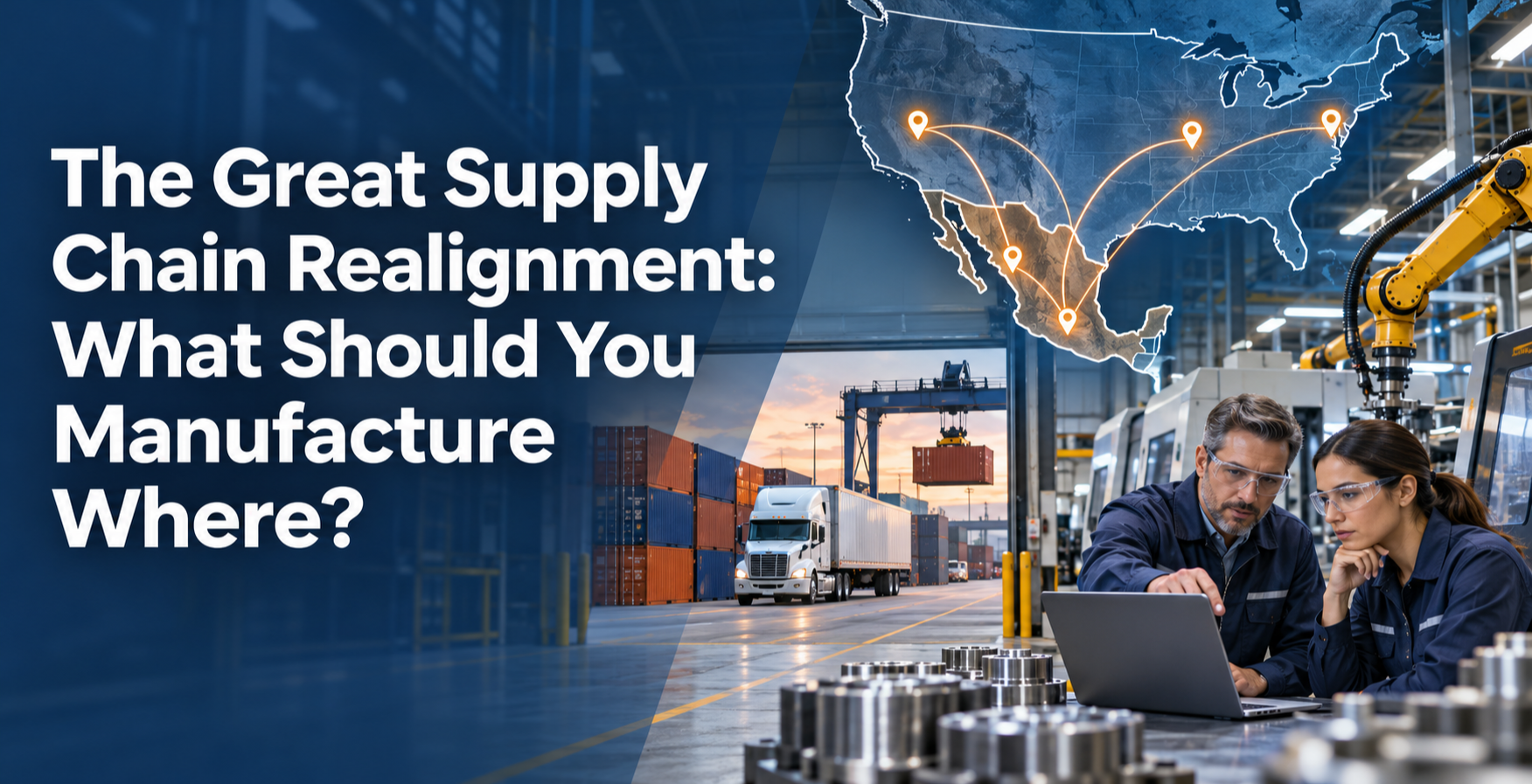
How manufacturers can compare total landed cost, regional capabilities, supply-chain dependencies, and execution risk before deciding where production belongs
A manufacturing-location decision is not a contest to find the lowest wage or the cheapest building. It is a system decision that changes logistics, inventory, tariff exposure, supplier dependencies, workforce requirements, capital risk, and the company's ability to respond when conditions change.
In this episode of MetaPod, Ron Crabtree speaks with manufacturing and supply-chain professional Javier Zarazua about the great supply-chain realignment and the practical question behind it: what should a company manufacture where?
Zarazua's advice is to build the full business case, trace critical dependencies beyond tier one, match the product to the region's actual capabilities, compare specific locations rather than country averages, and test the strategy before committing to a major move.
Watch or listen to the full MetaPod episode.
Start with the complete location equation
Companies often begin with a preferred answer: move to Mexico, reshore to the United States, or place a facility near a major customer. The analysis should begin before the destination is chosen.
Build a location matrix that compares the cost of land and construction, production and nonproduction labor, freight to each customer location, raw-material sourcing, tariffs, inventory, environmental requirements, infrastructure, and political and supply-chain risk. The goal is to understand total landed cost and the operating conditions behind it.
Low labor cost can be attractive, but it may not control the result. A highly automated process may gain less from a labor-cost advantage than a labor-intensive operation. A site with inexpensive real estate can become costly when transportation, inventory, utilities, regulatory requirements, or limited supplier capability are included.
The right comparison connects every major cost and risk to the product, customer footprint, and operating model. It should show what changes when one assumption moves rather than hiding the decision inside a single average.
Match the product to the regional ecosystem
A region needs more than available space and workers. It needs the industrial capabilities that support the product.
Mexico has mature ecosystems in areas such as automotive, industrial machinery, appliances, aerospace, and medical devices. Zarazua also points to the country's growing role in AI data-server production. Those strengths matter because an established ecosystem may provide experienced labor, suppliers, technical services, logistics infrastructure, and knowledge that a new facility cannot create quickly by itself.
The product and process still determine the fit. Leaders should ask whether the region can supply the required materials and skills, whether the operation depends on specialized processes, whether the customer base is nearby, and whether automation changes the labor equation.
A country-level answer is not enough. The question is whether a particular product, process, and supply network belong in a particular operating region.
Map dependencies through tier two and tier three
Moving final assembly does not automatically reduce supply-chain exposure. A company can relocate a production line and discover that the same critical components, trade routes, or tariff liabilities remain underneath it.
Map the bill of materials beyond direct suppliers. For each critical component, identify the tier-two and tier-three sources, raw-material origin, trade route, tariff treatment, lead time, intellectual-property considerations, and available alternatives.
Zarazua describes one company that intended to bring nearly all components from its established Korean supply base into a new Mexican operation. Tariff changes altered the economics. Standard machined and metal parts could be sourced in Mexico, while one specialized component made from a rare material was better left with the experienced Korean supplier.
The lesson is not to localize everything. Localize where the regional capability, economics, and risk support it. Preserve an established source where its expertise, intellectual property, or specialized process remains the stronger choice.
Compare cities, not just countries
Location conditions can change materially within a few hours' drive. Labor availability, wage rates, turnover, construction cost, transportation access, utilities, and the depth of the local industrial ecosystem differ from city to city.
Zarazua gives the example of Mexican industrial markets where a location farther from a major hub may offer substantially lower labor cost. That apparent advantage still needs to be tested against logistics, workforce depth, supplier access, customer distance, and the needs of the operation.
A practical site comparison should therefore move in stages: country or region, industrial corridor, city, and specific site. Each stage should retain the assumptions and evidence that caused one option to advance and another to be rejected.
Separate current cost from future uncertainty
Tariffs, trade agreements, currency movements, and public policy can change during a facility decision. Leaders should not pretend that one forecast eliminates that uncertainty.
Instead, model scenarios. Show the result under current conditions, plausible tariff changes, different demand levels, and disruptions to a critical source. Identify which assumptions would reverse the recommendation and which options remain workable across several scenarios.
This converts uncertainty from a reason to delay every decision into a factor the company can prepare to manage. The objective is not perfect prediction. It is knowing which variables matter and how quickly the business can respond.
Pilot before moving the network
A company does not always need to begin with a greenfield facility or a full-network transfer. It can test the strategy through a joint venture, a leased building, or one production line.
A pilot allows the business to validate workforce assumptions, supplier performance, quality systems, logistics, permitting, management capability, and customer response with less irreversible capital. It also gives the organization a real operating history instead of relying only on estimates.
The pilot still needs a decision framework. Define what the company is testing, which measures determine success, how long the test will run, what conditions trigger expansion, and what evidence would cause the business to stop.
Build proven optionality
Zarazua's closing principle is concise: proven optionality that is ready to execute is the best plan.
Optionality is more than a list of hypothetical alternatives. A useful option has been investigated, costed, tested where practical, and connected to an owner and trigger. The company knows which suppliers, sites, partners, and production routes it can activate when conditions support the move.
That preparation can include a qualified backup supplier, a validated regional source for standard components, a leased site that has passed preliminary review, or a pilot line that has demonstrated acceptable quality and throughput.
The business then avoids two extremes: committing too early to a major move or waiting until a disruption forces a rushed decision.
A practical manufacturing-location checklist
Before approving a manufacturing-footprint change, leadership should be able to answer the following questions:
- What is the complete landed-cost comparison, including inventory, tariffs, logistics, and capital?
- Does the selected region have the industrial capabilities the product and process require?
- Where do critical tier-two and tier-three components and raw materials originate?
- Which dependencies, tariffs, or trade routes remain after the move?
- How do the shortlisted cities differ in labor, infrastructure, suppliers, and customer access?
- Which assumptions could reverse the recommendation?
- Can the company test the strategy through a smaller, controlled pilot?
- What evidence will trigger expansion, revision, or exit?
Connect and learn more
The strongest footprint decision connects strategy to operational evidence. It compares the complete economics, understands the supply network beneath final assembly, and creates options the organization can actually execute.
Explore the full conversation with Javier Zarazua on MetaPod. If your organization needs experienced supply-chain or manufacturing leadership to assess a footprint decision, build regional capability, or stabilize execution, learn more about MetaExperts supply-chain management consulting or contact MetaExperts.