
Artificial intelligence is advancing faster than many manufacturing organizations can absorb it. Leaders are already managing labor shortages, pressure to do more with fewer resources, and digital transformation. AI creates opportunity, but also uncertainty.
In the latest episode of MetaPod, Ron Crabtree speaks with Nick Caruso and Sze Wong of KnowledgeNet.ai about how manufacturing leaders can respond to rapid AI adoption.
Their central message is clear: AI is rarely the biggest bottleneck. The greater challenge is how leaders understand, govern, and deploy it.
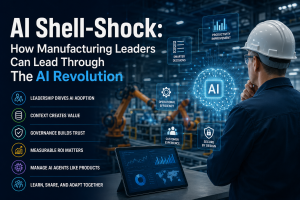
AI Adoption Must Start with Leadership
The first question leaders should ask is not whether the company uses AI. It is whether the executive team personally uses it.
Nick explains that executives cannot lead AI transformation effectively if they treat it only as an IT initiative. Leaders need firsthand experience using AI to prepare for meetings, review information, organize work, evaluate decisions, and challenge their thinking.
Consistent use helps leaders understand what AI does well, where it makes mistakes, what information it needs, and what risks must be controlled. Without that experience, executives may struggle to identify useful applications or evaluate recommendations.
Context Makes AI More Valuable
AI becomes more useful when it understands the organization it supports. Companies can securely connect AI to relevant information, including ERP and CRM platforms, financial systems, email, shared documents, operating procedures, and institutional knowledge.
With the right context, leaders can examine sales activity, financial performance, customer issues, operational constraints, and project progress without repeatedly rebuilding the background.
However, context does not mean giving every AI system unrestricted access.
Treat AI Agents Like Highly Capable Interns
Sze recommends treating an AI agent like a highly capable intern.
A company would not give a new intern access to every financial file, customer record, password, and confidential document. Access would reflect the person’s responsibilities. AI agents should be managed the same way.
Each agent should receive only the information, permissions, tools, and system access required for its role. Leaders should know which systems it can access, what it can read, whether it can change records or communicate externally, which credentials it uses, and what actions it has completed.
This becomes more important as AI begins updating records, preparing reports, reviewing invoices, following up on tasks, and supporting customers.
AI Initiatives Need Measurable ROI
A broad directive to “start using AI” is not an operating strategy.
Each initiative should be tied to a specific business outcome. Potential applications include increasing customer-support capacity, accelerating invoice processing, improving onboarding, supporting sales, automating project follow-up, reducing administrative work, and increasing output without adding headcount.
AI should not automatically be viewed as a direct replacement for employees. Its immediate value often comes from helping people work faster, manage more information, and focus on higher-value problems.
Before scaling an initiative, organizations should define expected costs, performance targets, service improvements, productivity gains, and return on investment.
Governance Should Enable Adoption
Security concerns are real, but they should not prevent all AI use.
One important step is creating separate machine accounts for AI agents instead of allowing them to operate through employee credentials. Machine accounts make it easier to define permissions, audit activity, and distinguish between human and AI actions.
Leaders should not simply ask, “Are we protected?” A stronger question is, “How are we protected, and what evidence shows that those controls are working?”
The episode also explores prompt injection, where someone manipulates an AI system into ignoring instructions or revealing protected information. In a business environment, this could expose credentials, confidential data, customer information, or internal instructions.
Technical teams should understand these risks, evaluate protections regularly, and stay current as models and attack methods evolve.
AI Agents Need Version Control
AI agents should be managed like software products. As models, instructions, tools, and system connections change, companies should maintain controlled versions of each agent. Version control allows teams to test capabilities, compare performance, identify unintended consequences, and roll back problematic changes.
Sze compares this to giving an employee a chainsaw. The organization should test the tool, understand its risks, establish boundaries, and define its proper use before distributing it broadly.
Companies should know which version is active, what changed, who approved it, and whether performance improved.
Give Employees the Opportunity to Experiment
Once leaders develop their own understanding, approved AI tools can be expanded across the organization.
Employees should be encouraged to explore how AI can reduce repetitive work, analyze information, and solve larger problems. Those who quickly discover valuable applications may become internal AI champions.
Experimentation still requires boundaries. Employees need approved tools, data-access rules, security guidance, and a process for escalating concerns.
Peer Groups Can Help Leaders Keep Up
The pace of AI change makes it difficult for any organization to keep up alone.
Peer groups allow leaders to compare applications, challenges, risks, and results. These conversations can help organizations benchmark their maturity and identify practical uses.
Leaders should not wait for AI to stabilize. The technology will continue to change. Organizations need the ability to learn, test, govern, and adapt continuously.
Connect and Learn More
The organizations that benefit most from AI will not necessarily be the ones with the most tools or the largest technology budgets.
They will be the organizations whose leaders understand how to integrate AI into daily work, connect it to meaningful business context, protect sensitive information, and hold each initiative accountable for measurable results.
Manufacturing leaders should begin by using AI themselves, identifying targeted business applications, establishing appropriate governance, and creating clear performance expectations for every AI agent and initiative.
To learn more, connect with Nick Caruso and Sze Wong of KnowledgeNet.ai on LinkedIn or by visiting KnowledgeNet.ai. You can also connect with Ron Crabtree on LinkedIn or contact the MetaPod team at [email protected].
MetaPod offers a wealth of knowledge and expertise for operational executives and organizations seeking to optimize their operations and supply chains, as well as common challenges such as digital transformation, the forever labor shortage, and doing more with less. Listen and subscribe today for more insightful and engaging discussions on operational excellence, leadership, growth strategies, and organizational transformation.