

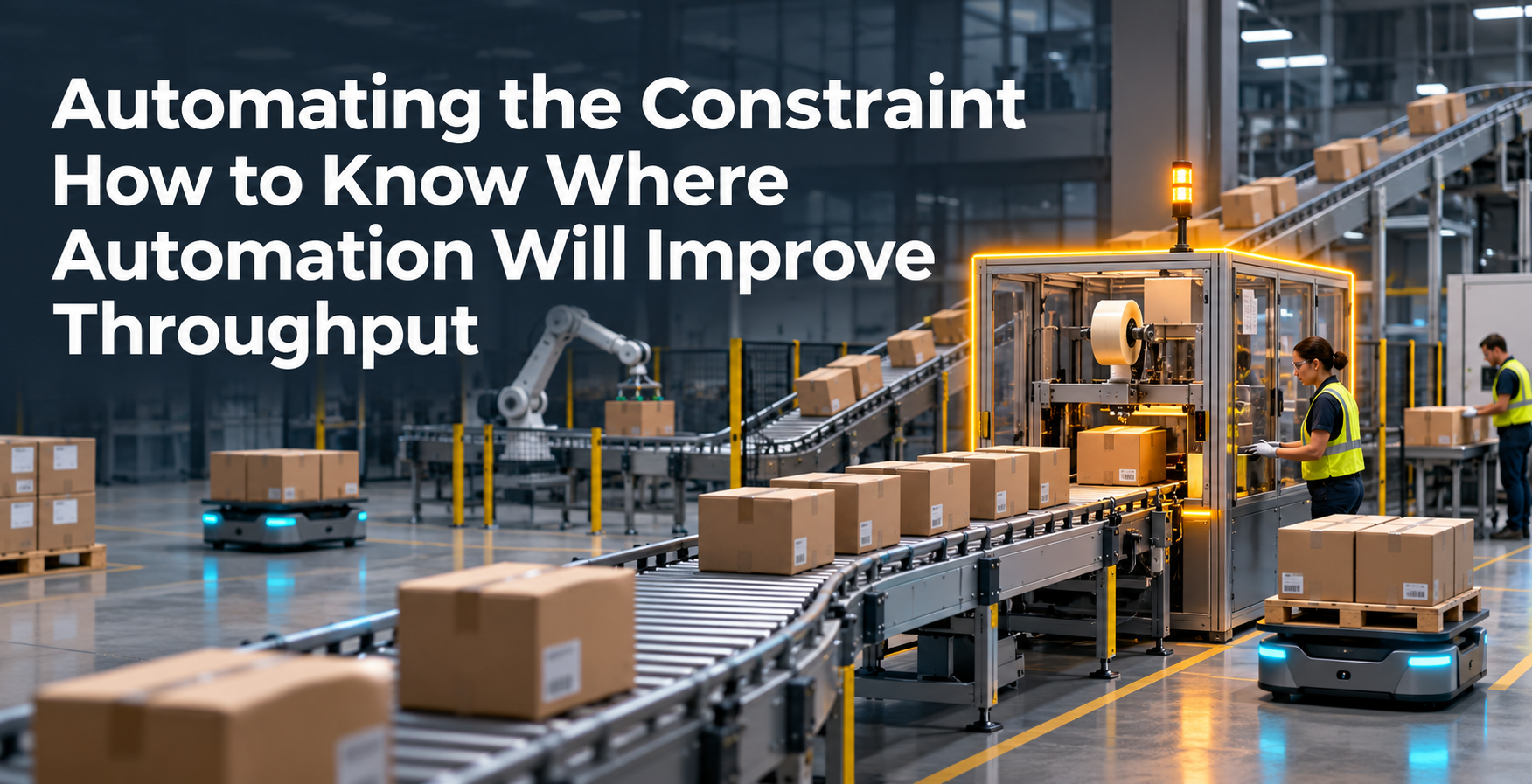
How manufacturers and distributors can find the real bottleneck, prepare it for automation, and add capacity without overbuilding
Automation can make one department faster while the customer waits just as long. That happens when a company invests where labor is visible or technology is attractive instead of finding the step that limits the entire operation.
In this episode of MetaPod, Ron Crabtree speaks with Phil Godden, an industrial engineer and supply chain leader with more than 40 years of experience. Godden leads automation work at Lift Incorporated and has designed facilities, selected systems, managed transportation and inventory, and helped companies justify capital projects.
His advice is to model the full operation, stabilize the real constraint, and match the investment to the useful throughput the business needs.
Find the system constraint
The department with the most people is not always the bottleneck. In a distribution center, picking may consume the most labor while packaging or shipping limits how many orders leave the building.
Automating picking in that situation moves orders to the queue faster. It does not improve customer throughput. The company may spend heavily and discover that the real constraint remains untouched.
Build a capacity model for each major step. Record operating hours, staffing, units per hour, demand patterns, and expected growth. The model should show which process reaches capacity first and what options remain for adding hours, labor, or equipment.
Use data and direct observation
Average volume can hide the day that breaks the system. In one autonomous mobile robot project, the customer described a manageable average rate. The data later showed that one day each week ran at roughly ten times that rate.
Pull information from the ERP, warehouse management system, and equipment logs. Then stand in the process and watch the flow. Look for queues, excess motion, uneven work release, missing supplies, and product that moves quickly through one step only to wait at the next.
Work release can be part of the constraint. When demand is schedulable, changing the sequence may improve flow without adding equipment. Moving information is usually easier than moving products.
Stabilize the bottleneck before automating it
Theory of constraints starts by using the current bottleneck as effectively as possible. Keep it running during available hours, protect it from poor quality and rework, and prevent work from piling up on either side.
The process also needs to work without a hero. If performance collapses whenever one experienced employee takes vacation, the rules and decisions are not documented well enough for automation.
Measure variation around the bottleneck. Godden prefers downstream steps to have more capacity than the process before them so completed work leaves the area instead of moving from one pile to another.
Map the work across departments
Many remaining constraints cross functional boundaries. A single manager may have already fixed the problems contained inside one department. The next opportunity often depends on several teams whose measures and budgets do not point toward the same result.
Create an end to end value stream view. Show where orders wait, where products are touched, which team owns each decision, and how a local improvement affects the next process.
Godden describes a company that requested automation for picking. The more serious issue appeared downstream, where employees handled the product repeatedly after the pick. The proposed system would have delivered work to the manual handling problem faster without reducing the total touches.
Prepare the work for automation
A picking operation should have the right product in the right storage medium. Slow moving items may fit on a shelf. Higher volume items may need flow lanes or full pallet access. Employees also need boxes, dunnage, labels, and other supplies where the work occurs.
Review the task itself. A picker who also packs, tapes, and handles unrelated steps may be doing work that belongs elsewhere. Remove those distractions and clarify the standard process before asking a robot or another automated system to perform it.
Test the operating scenarios
A pilot should expose real operating variation. In an autonomous mobile robot test, one robot served three production lines. A weekly demand spike made the obvious answer seem to be another robot.
The team found a lower cost option. Staging locations allowed the robot to make a quick pickup and drop, then complete longer moves to the stretch wrapper while operators were on break. The pilot also helped the team set priorities among the three lines and avoid running conflicting jobs at the same time.
The best solution combined route design, staging, mission logic, and production scheduling. More equipment was only one possible answer.
Add adaptable capacity
Retail and fulfillment operations may run steadily for 46 weeks and face a radically different requirement during six peak weeks. Building permanent automation for the peak can leave expensive assets idle for most of the year.
Design the base system for normal demand and give it a practical way to flex. The company may rent additional robots, add temporary manual put walls, or expand a modular goods to person system as volume grows.
Robots as a service can shift part of the decision from capital ownership to cost per pallet or other unit of useful work. The provider sizes the fleet, and the customer pays as the system produces value. The commercial model still requires careful review, but it can reduce the risk of overbuilding.
Connect and learn more
The most important automation decision comes before equipment selection. Leaders need to confirm that they are solving the problem that limits the system. A capacity model, direct observation, and a controlled pilot can keep capital focused on real throughput.
To learn more, connect with Phil Godden on LinkedIn or through Lift Incorporated. You can also connect with Ron Crabtree on LinkedIn or contact the MetaPod team at MetaExperts.com.